Doug's Safai News - Zakouma, Chad Latest Updates
 “Only a fool tests the depth of water with both feet”~ African ProverbThe rains are now towards the end for Southern Africa, and I think I would be right in saying the Kalahari areas of Namibia and Botswana have had exceptional rains – I have seen some incredible images of flooding rivers and flood plains from this area, which I am sure is a very welcome relief after the dry years previous! It seems like everywhere these days there is little normal rainfall - it is either way over or way under. I have some safaris coming up into Namibia and Botswana, so I am really looking forward to seeing what it all looks like. I have recently completed a long safari stint which started in Gabon with a one-week safari there which as usual an absolute pleasure having two beautiful parks essentially to ourselves. We saw lots of forest buffalo and forest elephants in Loango, a great Gorilla trek and everyone will remember the fun we had tracking and calling Red River Hogs plus the Elephant herds along the beach. Just such a pity there is so much plastic and other human made debris all along these beaches. In Pongara, we had the very special experience of watching Leather Back Turtles hatching and making their way along the beach into the sea and also a Green Turtle going through the laying and nesting process before going back to sea. Probably a more unique sighting – for me anyway – was while sitting on the beach in the night watching the turtles was then to see a pod of hippos come past in the surf on their way home. Outstanding! |
 |
 |
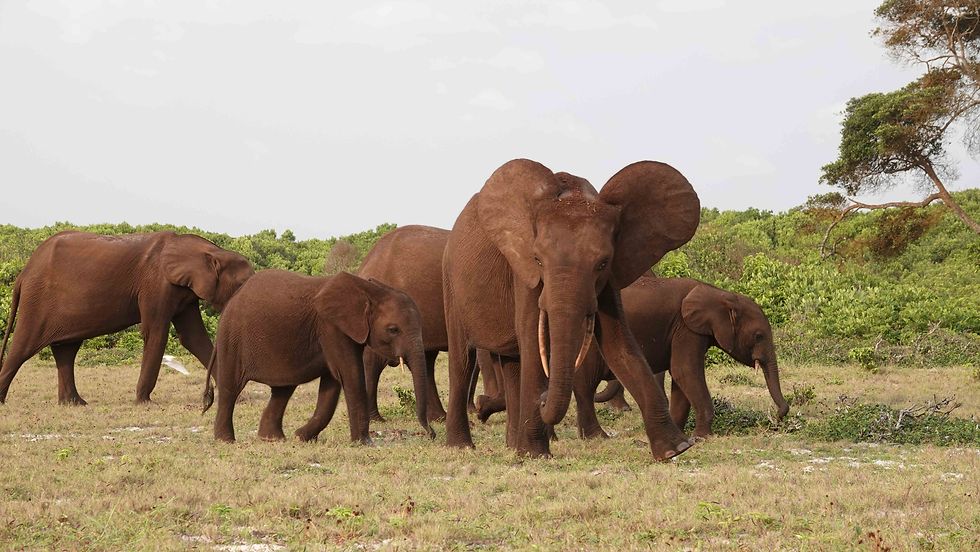
After Gabon I flew with my guests to Chad via Addis Ababa which all worked very well, to start my set date safaris that we do in Zakouma National Park every year. The contrast in climate and habitats between these two places could not be starker, so it was a great way to demonstrate the extraordinary variety of ecosystems and species in Africa and if we needed a lesson on humid versus dry heat, it was demonstrated perfectly. Zakouma has had the most amount of rain the management there has ever recorded so there was still quite a lot of water around and all the animals and birds looked in tip top condition. I saw a new mammal species for me in that area, which was the Zorilla or Striped Polecat. These are wide ranging creatures here in Africa but rarely seen so although it was a brief sighting it was a new one on my list for Zakouma. The elephant population continues to thrive there and estimated put them towards the 1000 mark and it is really starting to become noticeable the sign of elephant more wide ranging around the park as the family units continue to separate, but also the amount of tree damage is really starting to be very evident. Always a complex discussion as to what the limits are and what should or shouldn’t be done. On a very sad note the Black Rhino relocation project to Zakouma which has been an extraordinary human effort to make happen but has now been effected by the other side of human nature and had two of these Rhino poached for their horns, a real blow to the park and this project so I hope that it does not derail it completely, as these big animals are a very necessary part of these systems and they need places to like this to range in. If you would like to come and see Zakouma we have set are dates for next year, please get in touch and we can fit you into one of the small groups to come and experience this amazing National Park. |
 |
 |
My next set of safaris will be focused on Gonarezhou which is looking beautiful after the rain season. These particular safaris coming up are very much focused around walking and exploring new areas of the park, so I am really looking forward to those, and I am sure our great team there who have to keep moving the small fly camp every night to new places are up for the challenge. The good news is we will all be fitter and stronger to take on the “easier” safaris coming up this season in Gonarezhou. |
 |
Some other good news : - The Zambezi and Kavango Rivers which had unprecedented low flows last year are this year very high which is great news for all the downstream receivers of this water like Lake Kariba and the Okavango Delta –the main flood waters for these places will only really be noticeable once we get into May through July but some of those camps who could not offer boating activities in the Delta last year might well be doing so this year and you never know maybe the Savuti Channel will flow. More Good News – A question I am often asked is about adding the Ennedi Plateau, an area in the Sahara Desert of Chad, onto a Zakouma Itinerary. The problem has always been that for one or two people the air charter costs are eye watering! However, we now have a plan working with Camp Warda there so we can now offer (for set dates) the option of a 6-night stay in the Sahara. There is very limited space, but it is now an option that makes the selling of body parts to go there less necessary. |
 |
 |
From the Camp Fire – As we say good-bye to our migrant bird species like the sandpipers, and who should be arriving back in their Northern breeding grounds in the arctic areas in the not too distant future and I am sure some are already there. This is in itself is a fascinating and complex part of nature, these annual migrations. But I think you should also consider how extraordinary the design of these birds is. When you see these birds probing along the various wetland environments they live in you should consider… are they randomly sticking their bill in the sand hoping to get something or is it more calculated than that? On the tip of their bill, they have a densely packed mechano-receptors which they use like sonar. Each time they probe into the mud or sand the thin rivulets of water between the grains create a pressure wave which get distorted when they have to flow around something, and the bill senses those distortions. If they detect something of interest, they repeatedly push up and down many times a second in an area, this makes the grains of sand become denser and with this greater pressure the picture becomes clearer to them allowing to then probe exactly where this food is. Kind of like finding food by Sonar and making that probing behaviour very efficient! |
 |


